
With energy prices on the rise and growing concerns about energy security and carbon emissions, many homeowners are looking for cheaper and more sustainable alternatives to traditional gas and oil boilers. Heat pumps are getting cheaper and more efficient and the government’s Boiler Upgrade Scheme contributes £7,500 towards the installation cost at the moment. There’s never been a better time to consider a heat pump, especially if you have a gas or oil boiler that’s getting to the end of its life. So why are so many of us sceptical? I’ve been finding out more and visiting happy heat pump owners in Southampton.
What Is a Heat Pump?
A heat pump is an appliance that transfers heat from one place to another efficiently. Refrigerators, dehumidifiers and some modern tumble driers are heat pumps. Heat pumps are increasingly being used to heat and cool buildings using electricity, typically generating three to four times more heat from one unit of electricity than an electric boiler, even in very cold weather. Think of it as a refrigerator in reverse (1). In the same way that a bicycle pump gets hot when you pump up your tyres because the air inside the tube is compressed, a heat pump compresses refrigerant gas, which heats up and warms air or water to heat your home (and in many cases, your hot water too).
What are the different types of heat pumps used for heating homes?
There are several types of heat pumps, each suited to different property sizes and layouts; the most common used for homes are:
– Air-to-water Source Heat Pumps are the most common type in the UK. These units sit outside your home and pull heat from the air. They can warm your hot water as well as provide heat for your radiators or underfloor heating.
– Air-to-air Source Heat Pumps can warm your home in winter and cool it in summer by blowing hot or cold air into your rooms via blowers fitted at high level on the wall. Unlike an air-to-water source heat pump, they can’t provide hot water.
– Ground Source Heat Pumps use underground pipes to extract heat from the earth. They’re more efficient but require significant outdoor space and upfront investment.
I’ve heard they’re problematic, do they really work in Britain?
There are over 1000 ‘heat pump hosts’ up and down the country on the Visit a Heat Pump website who think they do and are willing to let you visit and see for yourself (2). Many installers believe so too and offer performance guarantees. Which? approved network of installers Heat Geek offers a seven-year performance guarantee for the entire heating and hot water system, which ensures it meets the efficiency levels quoted in the proposal. They cover the cost of rectification work if the performance falls short. They’ve installed thousands of heat pumps in the UK and they get an average seasonal coefficient of performance of 4.1, meaning they’re highly efficient, delivering 4.1 units of heat for every 1 unit of electricity used (3). To see live stats and find out who is ‘top of the SCOPs’ head to heatpumpmonitor.org (4). (SCOP = seasonal coefficient of performance, which is a measure of a heat pump’s average energy efficiency over an entire heating season).
What do real heat pump owners say?
I visited enthusiastic heat pump owner Simon and his family, as part of Green Open Homes Week organised by Transition Southampton (5). They had their air-to-water source heat pump installed to heat their home and hot water in time for last winter. They are delighted with how much warmer the house is now compared to how it was with their old gas-fired boiler. Even though they had extra insulation and bigger radiators installed, Simon believes the improvement in comfort is because the heat pump software frequently checks the temperature and keeps it constant throughout the day. Simon inspired his friend Mark, and his wife, to go through the heat loss survey and noise assessment with their energy supplier, British Gas. They opted to go ahead and have a heat pump installed. Once the installation was complete, British Gas even removed the gas supply and meter, so they no longer need to pay the standing charge (they have an electric hob for cooking). I was able to visit Mark as part of the Green Open Homes Week and he was keen to show me, and other homeowners, the benefits they enjoy from draught proofing and insulating their home and from their solar panels, heat pump and their garden allotment. Mark says: “Planning issues such as noise may arise with heat pumps and a noise assessment is done as part of the initial survey. Although our Vaillant heat pump is one of the quietest available, its proximity to our neighbour’s sitting area made noise a consideration. However, the actual noise is minimal, comparable to a fridge. Accommodating all the required tanks, including a hot water tank with 50% more volume, meant enlarging the size of our airing cupboard. The air-to-water source heat pump itself is fairly large and requires at least 250mm clearance from the wall. Replacing radiators is sometimes advisable for better energy savings; it was an obvious choice for us since our radiators were over 40 years old! Microbore pipework usually needs replacing, but ours did not. Installation caused about a week of disruption but so far, we are very happy with the increased level of comfort on the few cold days we’ve tested it”.
But what’s it like to live with a heat pump in the garden?
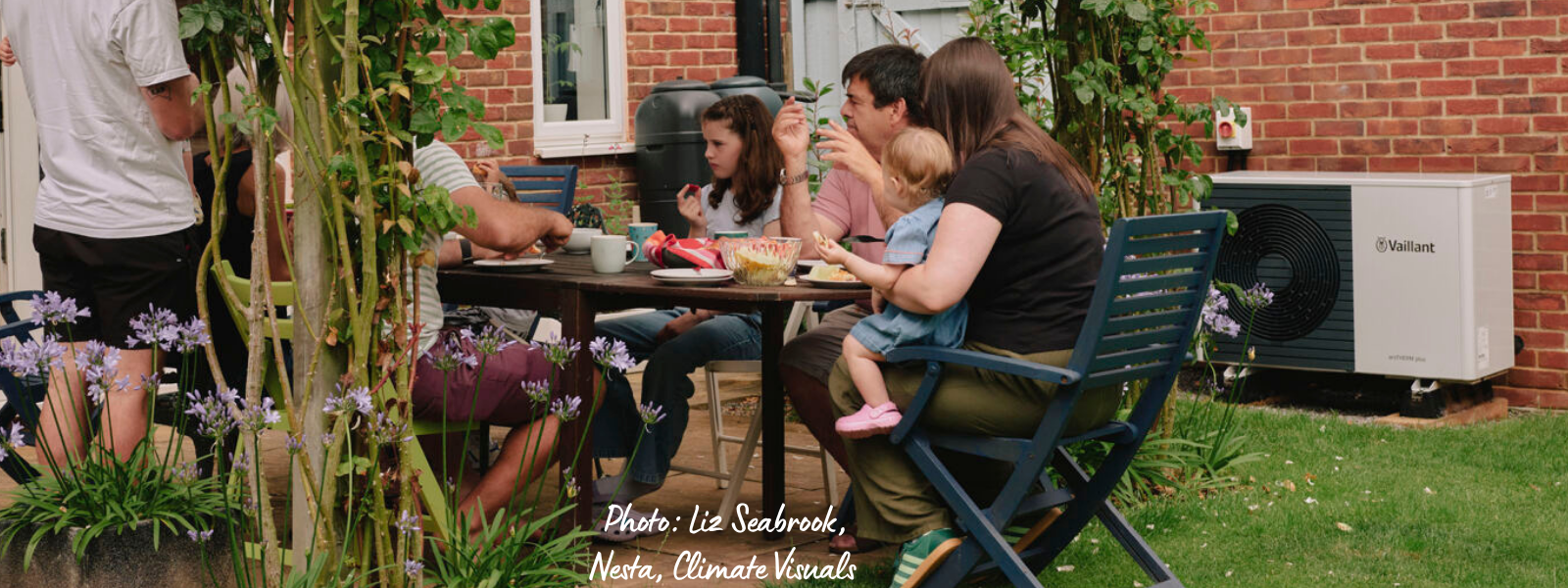
The photo above is by Liz Seabrook of Nesta and Climate Visuals. It shows the Pitkins dining by their heat pump in the garden of their four-bedroom home in Somerset in June 2025. The Pitkins had a Vaillant Aerotherm Plus heat pump installed in February 2024. The combination of their heat pump and roof mounted solar panels has reduced their dependence on traditional fuels and global market prices and significantly reduced their household fuel bill. “We can now afford to heat our home at a consistent temperature” says Nick, “and it is this consistency that is of benefit to both ourselves and our home…Our home feels comfortably warm 24/7, and there is minimal noise when the heat pump is running”. Photo reproduced by kind permission from ClimateVisuals.org, where you can find more real-life stories from families living with heat pumps (6).
OK, but why do heat pumps get so much bad press?
According to The Guardian, the UK government awarded a £100,000 contract to a ‘nudge unit’ to help dispel heat pump myths. The contract states that “misinformation shared in the media and by ‘other stakeholders’ is impeding uptake…Online information which is imbalanced or skewed towards incorrect and exaggerated claims could be considered an environment where misinformation is a problem”. These ‘other stakeholders’ may have a vested interest in maintaining our current supplies of gas boilers and gas (7).
Will the installation cost ever pay for itself in energy bill savings?
According to Money Saving Expert: “In theory, if your heat pump is four times more efficient than a gas boiler, you’d need a quarter of the electricity to heat your home (although it may not work out exactly in this way). But even at a quarter of the cost, electricity is still more expensive than gas if you’re on a standard price-capped tariff, and not much cheaper if you’re on a fixed tariff. This may change in the future but in the meantime, it’s worth considering a dedicated heat pump tariff. If you have an old inefficient boiler or electric storage heaters, the annual savings could be significant” (1). According to the Energy Saving Trust, an air source heat pump in a three-bedroom semi-detached house could save households £260 a year compared to an old inefficient gas boiler. (8). With the right tariff, significant savings can be made on energy bills. Heat pumps pair very well with overnight tariffs, solar panels and battery systems.
Can I get a grant to help with the cost?
The UK’s Boiler Upgrade Scheme offers £7,500 grants for eligible installations. Low-income households may qualify for additional help through local authorities (1). Air-to-water source heat pumps cost around £7,000–£15,000 including upgrading some or all radiators and a new hot water tank. Ground source heat pumps cost around £15,000–£30,000 including upgrading some or all radiators and a new hot water tank. To qualify for the Boiler Upgrade Scheme you must own the property, be replacing a fossil fuel heating system such as oil, gas, electric or LPG (liquefied petroleum gas) and have a valid Energy Performance Certificate (EPC) issued within the last 10 years. Check the government website to see if you’re eligible (9).
Will I have to insulate my home more and won’t that make it damp?
It is advisable to insulate and draught proof your home to save energy and money, regardless of the heating system used. To avoid damp and mould, it is important to ensure there is adequate trickle ventilation and that wet rooms such as kitchens and bathrooms have extractor fans to clear damp air from cooking and showering (there are heat exchanging options available and even whole-house ventilation systems, but this is another topic). The Centre for Sustainable Energy offers a range of helpful downloadable leaflets, covering topics such as achieving cavity wall insulation without being vulnerable to damp and mould. They even have a leaflet on how to insulate your loft on a DIY basis and also on understanding heat pumps and solar panels (10).
Will I have to replace all my radiators and plumbing?
Radiators and pipes become less efficient over time as limescale builds up, so if they are quite old you will see the benefits of replacing them regardless of whether you upgrade to a heat pump or not. Heat pumps do work best with larger radiators or underfloor heating, and you will need space for a hot water cylinder. If the pipes are microbore then they will probably need to be replaced to work with a heat pump.
How do I find out more and check if my home is suitable?
Why not phone The Environment Centre’s ‘My Home Made Better’ team, who offer up to an hour of free impartial advice to help Hampshire residents make their homes more comfortable, while saving energy and money (11). They are highly trained on heat pumps, solar panels, insulation, draught-proofing, ventilation and mould and damp. Their motto is ‘no insulation without ventilation’; which is sensible advice to avoid mould and damp! Have a look at the useful information on their website.
Where can I see a heat pump in action for myself?
I highly recommend using the Visit a Heat Pump website to visit one near you (2) or looking out for the next Southampton Green Open Homes Week (5). You can see (and importantly hear) a heat pump in action and ask the owner what it’s like living with one.
I’m interested but daunted, how can I get quotes from reputable installers?
It is worth seeking three or four comparable quotes and if proceeding, choose the installer you have the most confidence in, not necessarily the cheapest. Seek a quote from your energy provider and from reputable national and local companies. Ensure your installer is Trademark registered as well as certified with the Microgeneration Certification Scheme to qualify for a grant through the Boiler Upgrade Scheme. They will carry out the required energy survey and noise assessment to get the ball rolling and of course the final decision is up to you!
Carrie Lowe, Hampshire Architect
References:
1) Money Saving Expert https://www.moneysavingexpert.com/utilities/heat-pump/
2) Visit a heat pump near you https://www.visitaheatpump.com/
3) Heat Geek https://heatgeek.com/
4) Heat Pump Monitor, live heat pump data https://heatpumpmonitor.org/
5) Transition Southampton’s Green Open Homes Week https://transitionsouthampton.org/
6) Climate Visuals, Picturing Life with a Heat Pump https://www.climatevisuals.org/heatpumps/
7) Guardian Article about Government MythBuster Team https://www.theguardian.com/environment/2025/jan/01/uk-government-dispel-heat-pump-myths-misinformation-media
8) Energy Saving Trust https://energysavingtrust.org.uk/advice/in-depth-guide-to-heat-pumps/
9) Government Website about eligibility for Boiler Upgrade Scheme https://www.gov.uk/apply-boiler-upgrade-scheme
10) Downloadable leaflets from the Centre for Sustainable Energy https://www.cse.org.uk/resource/home-energy-advice-leaflets/
11) The Environment Centre’s ‘My Home Made Better’ informative website and free advice line https://myhomemadebetter.org/